Most wireless earbuds are still disposable by design: when a battery fades or a bud gets lost, the whole pair heads for a drawer — or a landfill. Fairphone has built its name on doing the opposite, and its second-generation Fairbuds, released today, push that idea further while fixing the first pair's biggest shortcomings.
The Fairbuds 2 are out now in the UK and Europe, priced at £99 / €119, with a US launch following on November 2 at $119. That undercuts the original Fairbuds, which debuted in Europe at €149 in 2024.
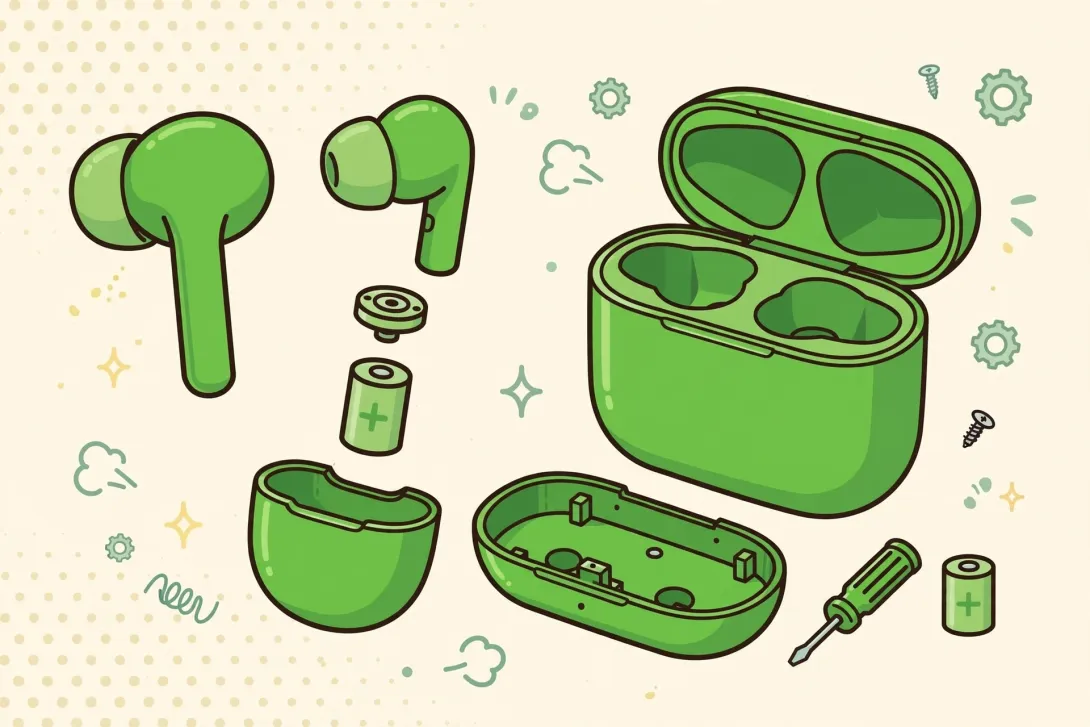
The redesign is obvious at a glance. Fairphone has moved to a stem-style design, offered in black or green, with a noticeably smaller and lighter build and a smaller charging case. Inside are new 11mm bio-cellulose dynamic drivers, refined active noise cancellation, and — for the first time in the Fairbuds line — support for Sony's LDAC codec, which can carry far more audio data over Bluetooth than the SBC and AAC codecs the original pair was limited to. Multipoint connectivity lets the buds stay connected to two devices at once, and a five-band equalizer in the companion app lets listeners tune the sound.
Battery life is the other headline upgrade. Fairphone rates the buds for up to eight hours on a single charge, dropping to six hours with ANC switched on, and up to 40 hours in total with the charging case. A 10-minute top-up is claimed to add two hours of playback. Charging is over USB-C; there is no Qi wireless charging.
Repairability, of course, is the whole point. The Fairbuds 2 keep seven user-replaceable parts, and the batteries in both the earbuds and the case can be swapped — Fairphone says the buds can be taken apart in seconds with a screwdriver and your fingers. Spare parts will be sold through Fairphone's own site, the buds carry an IP54 rating for dust and splash resistance, and warranty coverage runs up to three years. Fairphone also says 49 percent of the materials in the Fairbuds 2 are fair and recycled, including recycled plastics and fairly sourced minerals.
Early hands-on impressions from The Verge, which used the buds for a couple of weeks ahead of launch, describe good — if not class-leading — sound, simple touch controls that work well, and ANC that handled most background noise effectively. That is roughly the trade Fairphone is asking buyers to make: you give up a little polish compared with the biggest names at this price, and you gain earbuds designed to be repaired instead of replaced.
In a market where a single lost bud or a tired battery usually means buying a whole new set, that pitch lands differently in 2026 than it did two years ago — especially now that the price has come down, the battery lasts longer, and hi-res LDAC streaming is finally part of the package. For listeners who keep their gear for years, the Fairbuds 2 may be the easiest earbud recommendation Fairphone has made yet.